|
|
|
|
|
It is possible that the download link provided above does not refer to the intended version.
If you are looking for Models of the Hydrogen Atom, you may try searching for a download link using
Google.
This software was checked for viruses 2 months ago and was found to contain no viruses.
Click here
to see antivirus report.
|
|
| |
|
Review
This is official description applies to version 1.1
How did scientists figure out the structure of atoms without looking at them? Try out different models by shooting light at the atom. Check how the prediction of the model matches the experimental results. The sample Learning Goals are: - Visualize different models of the hydrogen atom. - Explain what experimental predictions each model makes. - Explain why people believed in each model and why each historical model was inadequate. - Explain the relationship between the physical picture of the orbits and the energy level diagram of an electron. - Engage in model building.
The following review written by one of the Software Informer contributors applies to version 1.0
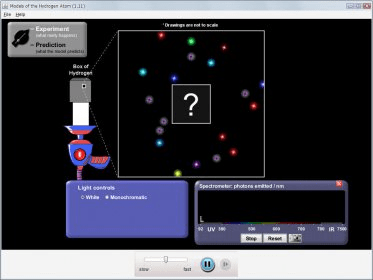
Models of the Hydrogen Atom is a physics simulation model. It illustrates how physicists attempted to predict what the structure of an atom was. The application has two modes: Experiment and Prediction. The first one duplicates the experiment that shows what really happens, i.e. the real structure of an atom. The Prediction mode shows an array of experiments physicists carried out and they results.
In the prediction mode there are six experiments. You can browse through them by clicking on their name. For example, the first prediction was what is called the billiard ball. Scientists believed that every particle that was shot at an atom's nucleus would bounce on it or would be expelled by it. The second prediction was the plum pudding. In this case, scientists posited that when a particle collided with the nucleus of an atom, it would be captured and then released.
The experiment mode shows that in reality the nucleus of an atom is a bit different. It shows that certain particles are deflected and thus something must be there doing the deflecting.
In short, this simulation model allows you to recreate experiments that were of paramount importance for the development of all the branches of science. |
- It doesn't require installation.
|
- It can use little on-screen help to help the user understand what the different predictions are based on.
|
|
Reviewed by: José Fernández Reviewer rating: Reviewed: Last year
|
|
Report a wrong version
Report a wrong program title
Suggest a correction
|
Screenshots
All 6 screenshots |